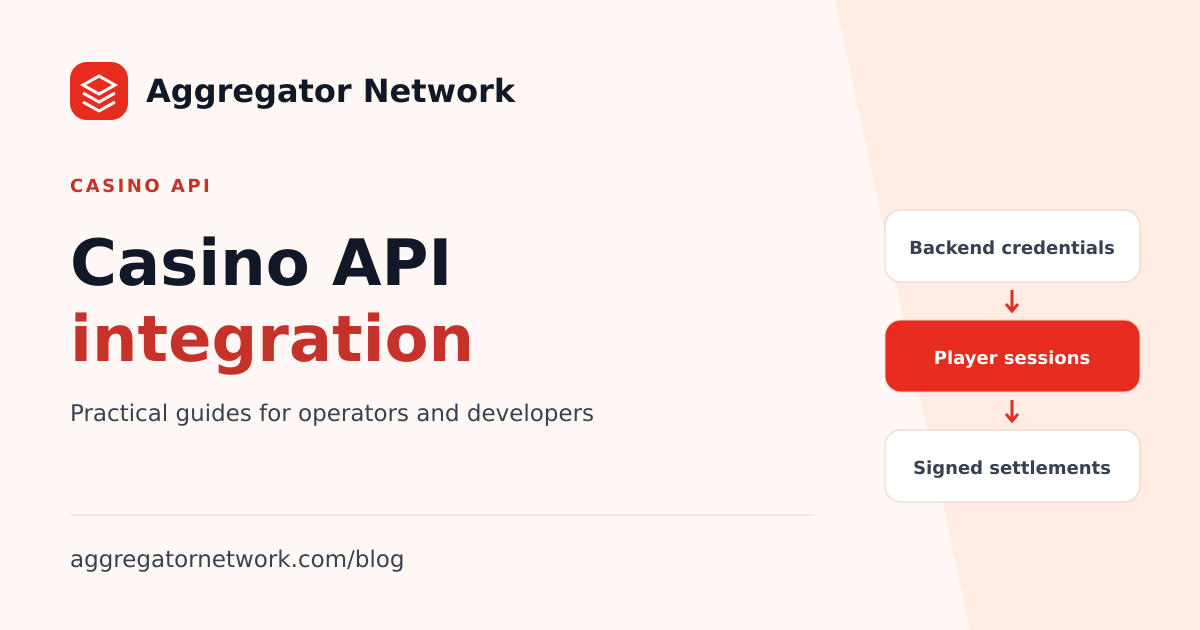
Casino API integration joins game discovery, player sessions and wallet settlement to an operator's existing platform. A successful connection gives your frontend a usable catalogue and launch flow while your backend retains the records needed to explain every reservation and settlement.
The work becomes easier to plan when you separate game access, player funds and production funding. This guide follows Aggregator Network's documented interface and turns those boundaries into an implementation sequence for your engineering and operations teams.
Define what your casino API must connect
Start with the experience you are delivering: a custom casino frontend, an existing operator platform, or a supplied website. Then identify which system owns player accounts, deposits, withdrawals, wallet balances, catalogue presentation and support. A game aggregation connection addresses game access and session operations; player payment processing must have its own confirmed integration scope.
The operator integration page sets out the Aggregator connection, while the integration model comparison explains how API access and website delivery fit together. Write down ownership before implementation so a successful game launch is not mistaken for a completed casino platform.
Keep credentials and catalogue access on the backend
Create backend services with the required API scopes and approved server egress IPs. The Application API Key belongs on your server, outside frontend bundles, screenshots and shared examples. Use the API getting-started guide and PHP, Node.js and Java examples to adapt requests to your stack.
Next, request the catalogue for an enabled play currency. Preserve the returned launch identifier, and confirm workspace entitlement for the games you intend to offer. Your lobby can cache display metadata, but your launch handler still needs to handle removed games or changes in access. The slot game API guide covers catalogue-driven lobby work in more detail.
Model a game launch as a recorded operation
Before calling getGame, reserve the player's starting funds in your own wallet. Record the player identifier, currency, game identifier, starting amount, approved return URLs and persisted idempotency key. Aggregator's command API does not debit your player wallet for you.
Check both the HTTP result and the documented application result. A network timeout after dispatch can leave an uncertain outcome, so an immediate second launch with a new operation key is not a reliable recovery strategy. Keep the original reservation attached to the operation while you establish what happened. Follow the launch API reference and error and idempotency guide for the current contract.
Build a settlement receiver that can explain its ledger
Your callback receiver should verify the HMAC signature against the exact delivered body bytes before processing the event. Use the body serial_number as the deduplication identity. Accepting the same event concurrently must not apply its financial effect twice.
The documented credit_amount is a balance snapshot after the round, not a delta to add to an operator-wide total. Associate it with the correct player and currency, preserve decimal precision, and reconcile delayed or out-of-order snapshots against your records. An HTTP 2xx response should follow durable acceptance, not precede it.
The settlement callback reference provides signature and recovery details. Use the wallet architecture guide to design the reservation and reconciliation flow around that contract. Keep operational request IDs so support can investigate a session without asking staff to share API secrets.
Separate player payments from GGR funding
There are three separate balances or purchases to account for: player funds in your own system, activation payments for platform access, and the workspace GGR wallet used for production operation. Paying for activation does not create player funds or credit the GGR wallet.
Review the workspace GGR guide and published pricing with your account team. The GGR calculator can help compare activity scenarios using the applicable rate and grouping rules; it does not replace your agreement or invoice records. Confirm any player deposit and withdrawal provider separately.
Use a production acceptance plan
Test the complete flow for one enabled game before expanding your inventory. Your test record should include catalogue selection, permitted demo behavior, a funded launch, an accepted settlement, a concurrent duplicate, a delayed event and an uncertain launch response. Assign an owner for each exception path.
Add desktop and mobile checks, approved return URLs, callback monitoring, catalogue refresh behavior and staff escalation procedures. Finish with the sandbox-to-production integration checklist. Product and territory access should match the scope you agreed to launch.
For a broader supplier decision, read how to evaluate an iGaming game aggregator. If you need the interface as well as the API, compare your frontend build with ready-made casino website delivery, then contact the integration team with the scope and evidence you have prepared.
Written from the current platform API documentation and integration handbook. For access confirmation or a documentation correction, contact the integration team.